Web cookies (also called HTTP cookies, browser cookies, or simply cookies) are small pieces of data that websites store on your device (computer, phone, etc.) through your web browser. They are used to remember information about you and your interactions with the site.
Purpose of Cookies:
Session Management:
Keeping you logged in
Remembering items in a shopping cart
Saving language or theme preferences
Personalization:
Tailoring content or ads based on your previous activity
Tracking & Analytics:
Monitoring browsing behavior for analytics or marketing purposes
Types of Cookies:
Session Cookies:
Temporary; deleted when you close your browser
Used for things like keeping you logged in during a single session
Persistent Cookies:
Stored on your device until they expire or are manually deleted
Used for remembering login credentials, settings, etc.
First-Party Cookies:
Set by the website you're visiting directly
Third-Party Cookies:
Set by other domains (usually advertisers) embedded in the website
Commonly used for tracking across multiple sites
Authentication cookies are a special type of web cookie used to identify and verify a user after they log in to a website or web application.
What They Do:
Once you log in to a site, the server creates an authentication cookie and sends it to your browser. This cookie:
Proves to the website that you're logged in
Prevents you from having to log in again on every page you visit
Can persist across sessions if you select "Remember me"
What's Inside an Authentication Cookie?
Typically, it contains:
A unique session ID (not your actual password)
Optional metadata (e.g., expiration time, security flags)
Analytics cookies are cookies used to collect data about how visitors interact with a website. Their primary purpose is to help website owners understand and improve user experience by analyzing things like:
How users navigate the site
Which pages are most/least visited
How long users stay on each page
What device, browser, or location the user is from
What They Track:
Some examples of data analytics cookies may collect:
Page views and time spent on pages
Click paths (how users move from page to page)
Bounce rate (users who leave without interacting)
User demographics (location, language, device)
Referring websites (how users arrived at the site)
Here’s how you can disable cookies in common browsers:
1. Google Chrome
Open Chrome and click the three vertical dots in the top-right corner.
Go to Settings > Privacy and security > Cookies and other site data.
Choose your preferred option:
Block all cookies (not recommended, can break most websites).
Block third-party cookies (can block ads and tracking cookies).
2. Mozilla Firefox
Open Firefox and click the three horizontal lines in the top-right corner.
Go to Settings > Privacy & Security.
Under the Enhanced Tracking Protection section, choose Strict to block most cookies or Custom to manually choose which cookies to block.
3. Safari
Open Safari and click Safari in the top-left corner of the screen.
Go to Preferences > Privacy.
Check Block all cookies to stop all cookies, or select options to block third-party cookies.
4. Microsoft Edge
Open Edge and click the three horizontal dots in the top-right corner.
Go to Settings > Privacy, search, and services > Cookies and site permissions.
Select your cookie settings from there, including blocking all cookies or blocking third-party cookies.
5. On Mobile (iOS/Android)
For Safari on iOS: Go to Settings > Safari > Privacy & Security > Block All Cookies.
For Chrome on Android: Open the app, tap the three dots, go to Settings > Privacy and security > Cookies.
Be Aware:
Disabling cookies can make your online experience more difficult. Some websites may not load properly, or you may be logged out frequently. Also, certain features may not work as expected.
Zach Muscavitch was awarded a grant from the American Philosophical Society for his project entitled “Resolving symbiont specificity for endemic lichens on the Channel Islands of California.” This project aims to collect Niebla lichens from the Channel Islands and characterize their fungal and algal symbionts applying a novel DNA sampling method: Target Capture. Results will complement those from the mainland to test patterns of isolation and reciprocal specificity between symbionts.
Olivia Lemieux, a graduating honors student who has been in the lab, mentoring by Niki and myself, has been awarded the Margaret F. Ertman Award in recognition of her significant accomplishments at University of Connecticut. Her project is entitled “Whole-range study reveals consistent hybrid nature and conserved progenitors of the North American endemic moss, Physcomitrium immersum.”
Each year, the Margaret F. Ertman Award is awarded to the outstanding senior across all four biology degree programs: Biological Sciences, EEB, MCB, and PNB. The student will have distinguished themselves both through outstanding scholarship in EEB, MCB, and PNB during their undergraduate career, and through original research conducted in biology (broadly defined) at UConn.
The Margaret F. Ertman Award was established in 1983 by Irvin L. Ertman (class of 1939) and Ronnie Ertman (class of 1941) in honor of their daughter Margaret F. Ertman (class of 1974). The award is based not only on your excellent presentation at the research colloquium but also on your superb academic performance throughout your UConn career.
Patiño J., I. Bisang, B. Goffinet, L. Hedenäs, S. McDaniel, S. Pressler, M. Stech, C. Ah-Peng, A. Bergamini, R.T. Caners, C. Cargill, N. Cronberg, J. Duckett, S. Eppley, N. Fenton, K. Fisher, J. M. González-Mancebo, M. Hasebe, J. Heinrichs†, K. Hylander, M.S. Ignatov, J. Martínez-Abaigar, N. Medina, R. Medina, D. Quandt, S. Rensing, K. Renzaglia, M. Renner, R. M. Ros, A. Schäfer-Verwimp, J. Carlos Villarreal & A. Vanderpoorten. 2022. Unveiling the nature of a miniature world: A horizon scan of fundamental questions in bryology. Journal of Bryology 41: 1–34. pdf
Abstract reads: INTRODUCTION Half a century since the creation of the International Association of Bryologists, we carried out a review to identify outstanding challenges and future perspectives in bryology. Specifically, we have identified 50 fundamental questions that are critical in advancing the discipline.
METHODS We have adapted a deep-rooted methodology of horizon scanning to identify key research foci. An initial pool of 258 questions was prepared by a multidisciplinary and international working group of 32 bryologists. A series of online surveys completed by a broader community of researchers in bryology, followed by quality-control steps implemented by the working group, were used to create a list of top-priority questions. This final list was restricted to 50 questions with a broad conceptual scope and answerable through realistic research approaches.
KEY RESULTS The top list of 50 fundamental questions was organised into four general topics: Bryophyte Biodiversity and Biogeography; Bryophyte Ecology, Physiology and Reproductive Biology; Bryophyte Conservation and Management; and Bryophyte Evolution and Systematics. These topics included 9, 19, 14 and 8 questions, respectively.
CONCLUSIONS Although many of the research challenges identified are not newly conceived, our horizon-scanning exercise has established a significant foundation for future bryological research. We suggest analytical and conceptual strategies and novel developments for potential use in advancing the research agenda for bryology.
Olivia presented her undergraduate research project entitled “Conserved progenitors of the hybrid moss Physcomitrium immersum across North America” at the EEEB undergraduate research symposium and was selected to compete at the All Biology undergraduate research symposium on Friday, April 29th. Congrats and good luck!
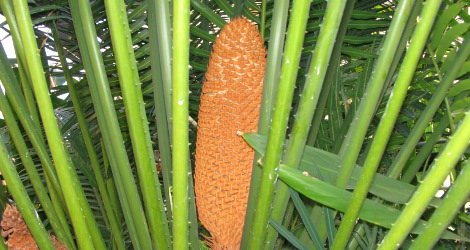
Liu Y., S. Wang, L. Li, T. Yang, S. Dong, T. Wei, S. Wu, Y. Liu, Y. Gong, X. Feng, J. Ma, G. Chang, J. Huang, Y. Yang, H. Wang, M. Liu, Y. Xu, H. Liang, J. Yu, Y. Cai, Z. Zhang, Y. Fan, W. Mu, S. Kumar Sahu, S. Liu, X. Lang, L. Yang, N. Li, S. Habib, Y. Yang, A.J. Lindstrom, P. Liang, B. Goffinet, S. Zaman, Jill. L. Wegrzyn, D. Li, J. Liu, J. Cui, E.C. Sonnenschein, X. Wang, J. Ruan, J.-Y. Xue, Z.-Q. Shao, C. Song, G. Fan, Z. Li, L. Zhang, J. Liu, Z.-J. Liu, Y. Jiao, X.-Q. Wang, H. Wu, E. Wang, M. Lisby, H. Yang, J. Wang, X. Liu, X. Xu, N. Li, P.S. Soltis, Y. Van de Peer, D.E. Soltis, X. Gong, H. Liu, S. Zhang. 2022. The cycad genome and the early evolution of seed plants. Nature Plants 8: 389–401. pdf Google Scholar
Abstract reads: Cycads represent one of the most ancient lineages of living seed plants. Identifying genomic features uniquely shared by cycads and other extant seed plants, but not non-seed-producing plants, may shed light on the origin of key innovations, as well as the early diversification of seed plants. Here, we report the 10.5-Gb reference genome of Cycas panzhihuaensis, complemented by the transcriptomes of 339 cycad species. Nuclear and plastid phylogenomic analyses strongly suggest that cycads and Ginkgo form a clade sister to all other living gymnosperms, in contrast to mitochondrial data, which place cycads alone in this posi- tion. We found evidence for an ancient whole-genome duplication in the common ancestor of extant gymnosperms. The Cycas genome contains four homologues of the fitD gene family that were likely acquired via horizontal gene transfer from fungi, and these genes confer herbivore resistance in cycads. The male-specific region of the Y chromosome of C. panzhihuaensis contains a MADS-box transcription factor expressed exclusively in male cones that is similar to a system reported in Ginkgo, suggesting that a sex determination mechanism controlled by MADS-box genes may have originated in the common ancestor of cycads and Ginkgo. The C. panzhihuaensis genome provides an important new resource of broad utility for biologists.
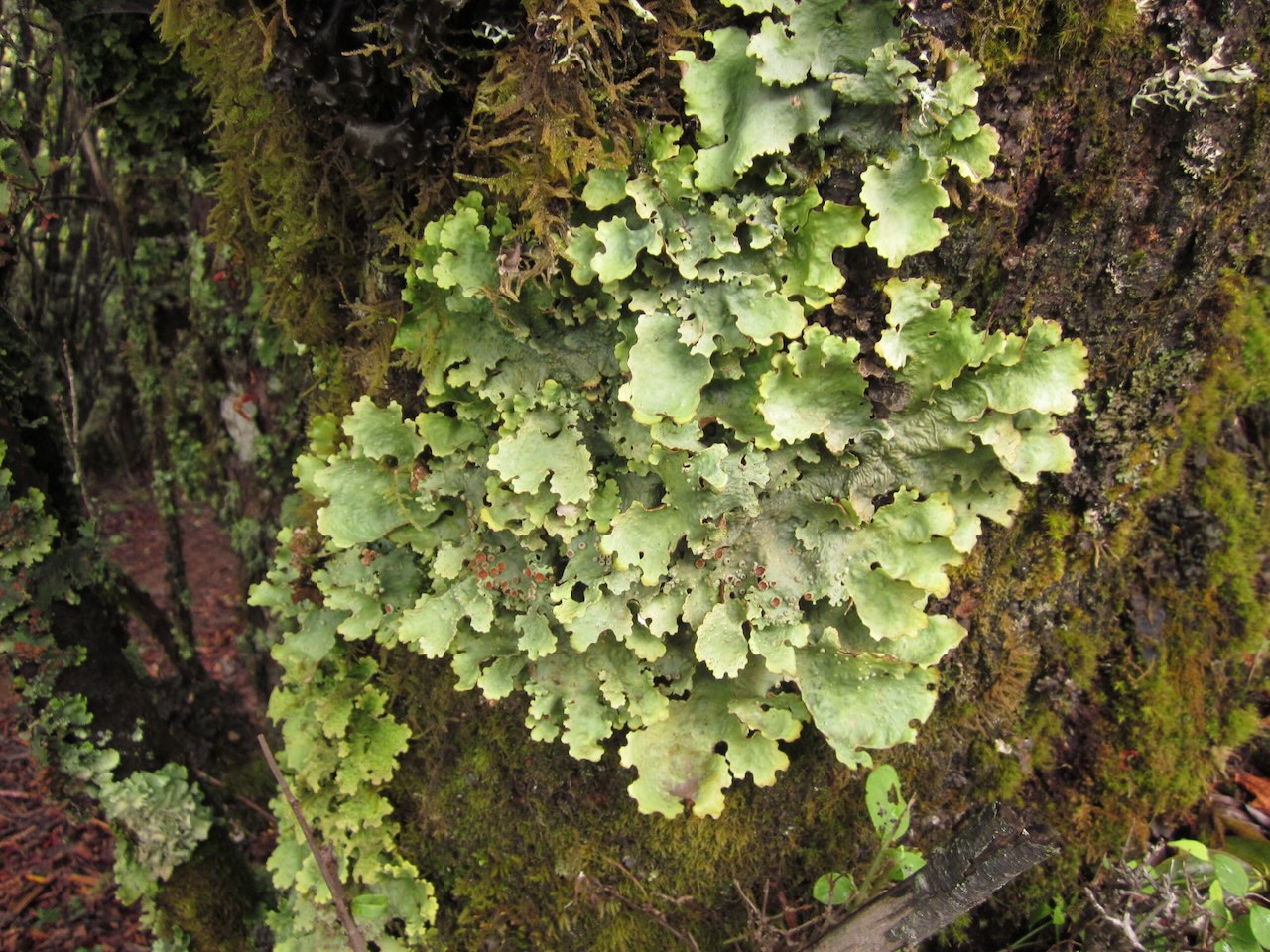
Simon A., B. Goffinet, L.S. Wang, T. Spribille, T. Goward, T. Pystina, N. Semenova, N.V. Stepanov, B. Moncada, R. Lücking, N. Magain & E. Sérusiaux. 2022. Global phylogeny and taxonomic reassessment of the genus Dendriscosticta (Ascomycota: Peltigerales). Taxon 71: 256–287. pdfGoogle Scholar
Abstract reads: The genus Dendriscosticta (Ascomycota: Peltigerales) encompasses several distinctive lichen-forming fungal species restricted to the Northern Hemisphere. Most are flagship species of old-growth forests with good air quality. A global phylogeny ofthe genus based on multilocus sequence data (ITS,RPB1,EF-1α,MCM7), model-based phylogenetic methods, and morphologicaland chemical assessments, reveals a high level of cryptic speciation often associated with restricted geographical distribution and/orchemical characters. Using sequence-based species delimitation approaches, we circumscribe two main clades referred to as the D. wrightii clade, with five unequivocal species, including D. gelida sp. nov., and the D. praetextata clade, with eight putative species, including D. phyllidiata sp. nov. The absence of recently collected material of D. hookeri comb. nov. from the type locality unfortunately prevents assignment of this epithet to one of the five supported lineages sharing this morphotype. Three new combinations are proposed: D. hookeri, D. insinuans comb. nov. and D. yatabeana comb. nov. Epitypes are designated for D. wrightii and D. yatabeana. Species diversity within the genus increased from four to nine. Our morphological assessment confirmed that Sticta and Dendriscostictacan be readily distinguished by the presence of excipular algae whereas the structure of the lower surface pores is not a reliable diagnostic feature.
Antoine Simon, currently a BAEF fellow with us has been awarded a highly competitive two year Marie Skłodowska-Curie Postdoctoral Fellowship from the European Union, for his project entitled “FRAME – Fungal Research in the Age of Museomic Exploration: revisiting historical lichen collections”.
Antoine will move this summer to the Natural History Museum, University of Oslo to work with Prof. Einar Timdal on genomic approaches applied to historical herbarium specimens.
His project aims at generating informative genetic data from ancient lichen collections, providing a cost-effective and labor-saving strategy to integrate relevant museum collections in biodiversity research.
Yu J., Y. Cai, Y. Zhu, Y. Zeng, S. Dong, K. Zhang, S. Wang, L. Li, B. Goffinet, H. Liu & Y. Liu. 2022. Chromosome-level genome assemblies of two Hypnales mosses reveal high intergeneric synteny. Genome Biology and Evolution 14: evac020. pdfGoogle scholar
Abstract reads: Mosses compose one of the three lineages of bryophytes. Today, about 13,000 species of mosses are recognized from across the globe, and at least a third of this diversity composes the Hypnales, a lineage characterized by an early rapid radiation. We sequenced and de novo assembled the genomes of two hypnalean mosses, namely Entodon seductrix and Hypnum curvifolium, based on the 10x genomics and Hi-C data. The genome assemblies of E. seductrix and H. curvifolium comprise 348.4 Mb and 262.0 Mb, respectively, estimated by k-mer analyses to represent 93.3% and 97.2% of their total genome size. Both genomes were assembled at the chromosome-level, with scaffold N50 of 30.0 Mb and 20.7 Mb, respectively. The annotated genome of E. seductrix comprises 25,801 protein-coding genes and that of H. curvifolium 29,077, estimated to represent 96.8% and 97.2%, respectively, of the total gene spaces based on BUSCO assessment. For both genomes, most contigs were anchored to the largest 11 pseudomolecules, corresponding to the 11 chromosomes of the two species, and each with a putative sex-related chromosome characterized by low gene density. The chromosomes of E. seductrix and H. curvifolium are highly syntenic, suggests limited architectural shifts occurred following the rapid radiation of the Hypnales. We compared their genomic features to the model moss Physcomitrium patens. The hypnalean moss genomes lack signatures of recent whole genome duplication (WGD). The presented high-quality moss genomes provide new resources for comparative genomics to potentially unveil the genomic evolution of derived moss lineages.
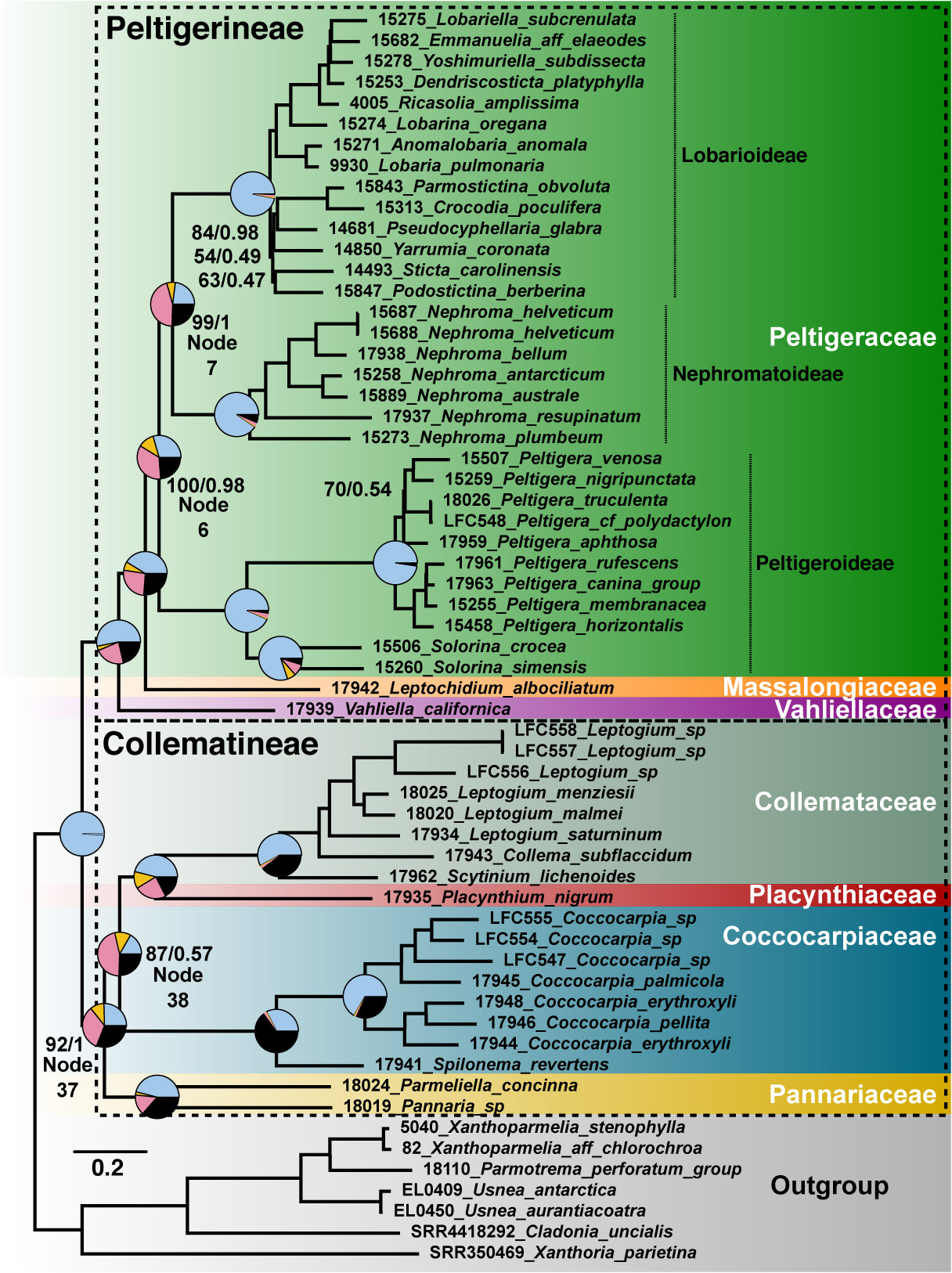
Widhelm T.J., F. Grewe, B. Goffinet, M. Wedin, T. Goward, L.F. Coca, I. Distefano, A. Košuthová & H.T. Lumbsch. 2021. Phylogenomic reconstruction addressing the Peltigeralean backbone (Lecanoromycetes, Ascomycota). Fungal Diversity 110: 59–73. pdfGoogle scholar
Abstract reads: Rapid radiations in Fungi are only beginning to be studied with phylogenomic data. The evolutionary history of the lichenized fungal order Peltigerales has not been well resolved, particularly for the Collematineae. Here, we used concatenation and coalescent-based species tree methods to reconstruct the phylogeny of the Peltigerales based on sequences of 125 nuclear single-copy exon sequences among 60 samples, representing 58 species. Despite uneven, lineage-specific missing data and significant topological incongruence of individual exon trees, the resulting phylogenies were concordant and successfully resolved the phylogenetic relationships of the Peltigerales. Relationships in the Collematineae were defined by short branches and lower nodal support than in other parts of the tree, due in part to conflicting signal in exon trees, suggesting rapid diversification events in the early evolution of the suborder. Using tree distance measures, we were able to identify a minimum subset of exons that could reconstruct phylogenetic relationships in Peltigerales with higher support than the 125-exon dataset. Comparisons between the minimum and complete datasets in species tree inferences, bipartition analyses, and divergence time estimations displayed similar results, although the minimum dataset was characterized by higher levels of error in estimations of divergence times. Contrasting our inferences from the complete and minimum datasets to those derived from few nuclear and mitochondrial loci reveal that our topology is concordant with topologies reconstructed using the nuclear large subunit and mitochondrial small subunit ribosomal DNA markers, but the target capture datasets had much higher support values. We demonstrated how target capture approaches can effectively decipher ancient rapid radiations in cases where well resolved individual exon trees are sufficiently sampled and how to identify subsets of loci that are appropriate for fungal order-level phylogenetics.
Antoine Simon, who graduated from the University of Liège, Belgium, is joining our lab for a year, based on a fellowship from the Belgian American Educational Foundation. Antoine’s research focuses on lichenized fungi and their symbiotic partners, their evolution and diversification, and interactions.
Antoine has stayed at UCONN twice before as part of his Master’s thesis and doctoral dissertation projects.